
Note: I wrote a similar title for a blog post I was writing at work, but some of the kids thought no-one would get the reference (probably because they didn’t and didn’t want to look stupid). So if you get the reference, please let me know!
Anyway, onto our regular scheduled show:
I’ve tried minimisation, I’ve tried to get rid of stuff. I’ve followed the advice that tells us that the path to inner peace means owning fewer things. Be ruthless and eliminate technological excess because that’s what is causing brainrot.
I’ve arrived at the conclusion that this advice is largely written by the kinds of people who fold their socks into tiny origami sculptures and describe their morning routine as “intentional.”
What happens when we try to put everything into one device though? For me, it means constantly switching between seventeen different apps, each one screaming for attention. Was I using my phone, or was my phone using me? Constant email notifications, social media updates, news alerts, and the persistent feeling that I should probably check if anyone had replied to that message I sent three minutes ago.
On the flip side, my wife glides through life with the latest iPhone, perpetually attached to her hand and buds in ears. She’s on it constantly, chatting, reading, messaging, scrolling, shopping, navigating, photographing. It’s impressive, really. She’s achieved a level of single-device mastery that borders on the supernatural.
I, on the other hand, have gone in the complete opposite direction. I bought an affordable Samsung A55 phone and a small Samsung tablet and a Mac Mini. Combined, they cost less than her latest iPhone. And this is how I discovered digital compartmentalisation.
It sounds like something a management consultant would charge you three thousand pounds to explain in a PowerPoint presentation – maybe I should put this post behind a paywall, but I’m a generous person. The concept is stupidly simple. Instead of trying to do everything on one device, I’ve split my digital life across multiple devices, each with its own specific purpose.
The phone is for phone things like calls, messages, paying for parking, maps, the occasional emergency Google search when I’m out and need to settle an argument about whether penguins have knees. (They do, apparently. You’re welcome.) But, it’s not for <everything>. I’ve deliberately kept it lean.
The small tablet is for reading. I’ve read more books and articles on my tablet in the last few weeks than in the last year. I put this down to not having all the other notifications and distractions, and of course having a bigger screen helps me focus.
The Mac Mini handles the serious work like writing, research, vibe-coding, or anything that requires an actual keyboard and the ability to have more than one window open.
My life has felt a lot more calmer, which is strange considering I now have more technology than before.
I think the problem isn’t down to the number of devices, it’s more about lacking boundaries. When everything is on one device, everything becomes a jumbled mess. Yes, I’ll reply to that email, while I’m halfway through reading a chapter, and ooh better keep that TikTok streak going with Andy before midnight. The last time I missed a day and reset our streak, he didn’t speak to me for 3 days.
This compartmentalisation creates a good kind of friction. And I know it’s not just me. When I was at dinner with Thom a week or so ago, he gave me an update on the book he was writing and pulled out this portable keyboard and a tiny distraction-free writing display.
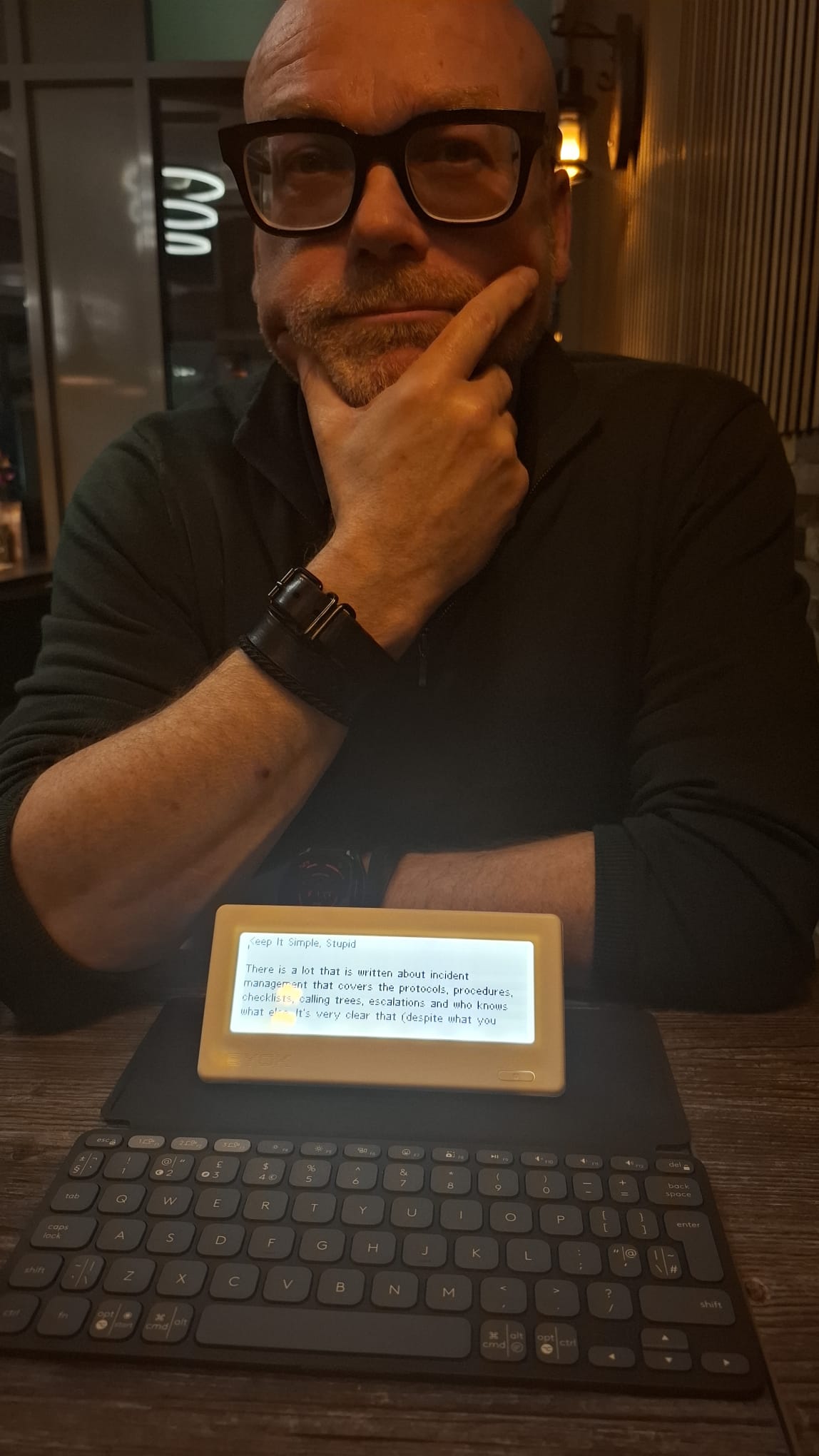
It was exciting to see how he too was embracing digital compartmentalisation to help him focus and write his book.
While at the conference the next day, in an attempt to sound intelligent, I was sharing this concept with an attendee, who said, “It sounds a lot like Zero Trusting Yourself” and I thought that it’s a far label than what I called it. So, I should really update the title of this post to
Zero Trusting Myself: Or How I Learned to Stop Worrying and Love Multiple Screens
But a lot of you kids probably wouldn’t get the reference.
 Javvad Malik